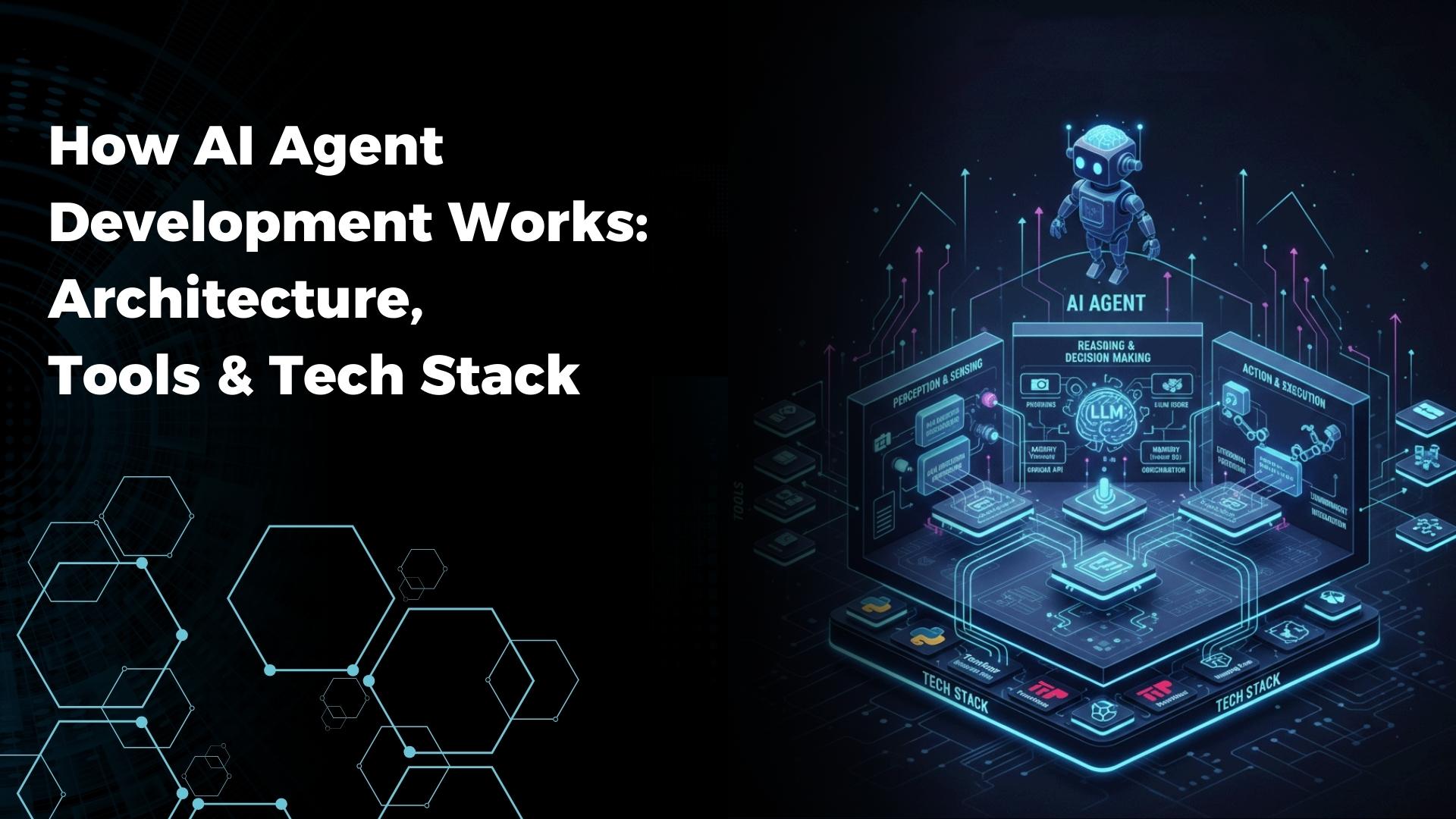
How AI Agent Development Works: Architecture, Tools & Tech Stack
Artificial Intelligence is rapidly moving beyond basic automation and rule-based chatbots. Today, AI agents are powering intelligent systems that can reason, plan, and act independently. Businesses are increasingly investing in AI agent development to automate workflows, improve decision-making, and scale operations efficiently.
In this blog, we explain how AI agent development works, covering its architecture, essential tools, and modern technology stack.
What Is an AI Agent?
An AI agent is an intelligent software system designed to interact with its environment, make decisions, and take actions autonomously to achieve specific goals.
An AI agent can:
Understand user or system inputs
Analyze context and intent
Make logical decisions
Execute actions without manual intervention
Learn from previous interactions
Unlike traditional automation tools that follow fixed rules, AI agents are goal-driven, adaptive, and context-aware, making them suitable for complex business processes.
AI Agent Development Architecture Explained
A scalable AI agent is built using a modular architecture that allows flexibility, learning, and integration.
1. Perception Layer
The perception layer enables the AI agent to collect and interpret inputs from different sources.
Input sources include:
Text conversations and commands
Emails, documents, and knowledge bases
APIs, databases, and system logs
Voice inputs and events
Technologies used:
Natural Language Processing (NLP)
Speech-to-text models
Data extraction and parsing tools
This layer ensures the agent understands what is happening in its environment.
2. Reasoning & Decision-Making Layer
This is the core intelligence layer of an AI agent.
It allows the agent to:
Identify user intent
Analyze context and constraints
Apply business logic
Select the best course of action
Most modern AI agents use large language models (LLMs) combined with rule-based logic or machine learning algorithms to improve accuracy and reliability.
3. Planning Layer
The planning layer enables AI agents to break complex goals into smaller, manageable tasks.
For example, an AI sales agent can:
Analyze lead data
Draft a personalized email
Schedule a follow-up
Update the CRM automatically
Planning allows AI agents to handle multi-step workflows dynamically.
4. Action & Execution Layer
Once a plan is ready, the AI agent executes actions such as:
Calling internal or third-party APIs
Sending emails or notifications
Updating databases or CRM systems
Triggering workflows and automation
This layer converts intelligence into real business outcomes.
5. Memory & Learning Layer
Memory enables AI agents to retain information and improve over time.
Types of memory include:
Short-term memory for conversation context
Long-term memory using vector databases
Knowledge memory for domain-specific data
This allows AI agents to deliver personalized, consistent, and context-aware responses.
Tools Used in AI Agent Development
AI agent development relies on a combination of AI frameworks, databases, and integrations.
AI Agent Frameworks
These frameworks help orchestrate reasoning, memory, and tool usage:
LangChain
AutoGen
CrewAI
Semantic Kernel
They allow AI agents to interact with external tools intelligently rather than generating static responses.
Vector Databases
Vector databases store embeddings and enable fast information retrieval:
Pinecone
FAISS
Weaviate
ChromaDB
They are critical for retrieval-augmented generation (RAG) systems.
API & System Integrations
AI agents integrate seamlessly with:
CRM and ERP platforms
Marketing automation tools
Analytics and reporting systems
Cloud services and SaaS platforms
This transforms AI agents into digital workers.
AI Agent Technology Stack
Frontend Layer
Web-based chat interfaces
Admin dashboards
Voice-enabled interfaces (optional)
Backend Layer
Python or Node.js
REST or GraphQL APIs
Agent orchestration services
AI & Data Layer
Large language models
Fine-tuned domain models
Vector databases
SQL and NoSQL databases
Infrastructure
Cloud platforms (AWS, Azure, GCP)
Docker and Kubernetes
CI/CD pipelines
AI Agents vs Traditional Automation
Business Use Cases of AI Agents
AI agents are widely adopted across industries:
Customer support automation
Sales and lead qualification
HR onboarding and recruitment
IT operations and monitoring
Data analysis and reporting
Organizations using AI agents experience faster execution, reduced costs, and improved efficiency.
Conclusion
AI agent development combines intelligent architecture, advanced tools, and a scalable tech stack to create autonomous systems that go far beyond traditional automation. As businesses move toward digital transformation, AI agents will become essential for maintaining competitiveness and operational efficiency.
Build Intelligent AI Agents for Your Business
Looking to develop custom AI agents aligned with your workflows?
👉 Connect with our AI experts to design, develop, and deploy scalable AI agent solutions.
Frequently Asked Questions
What is AI agent development and how can it help my business?
AI agent development involves building intelligent software agents that can understand inputs, make decisions, and perform tasks autonomously. For businesses, AI agents reduce manual effort, automate workflows, improve customer experience, and increase operational efficiency.
How do AI agents work in real business workflows?
AI agents analyze user or system inputs, apply reasoning and planning logic, and execute actions such as API calls, data updates, or communications. They can handle multi-step workflows like customer support, sales follow-ups, HR processes, and IT automation.
What makes AI agents better than traditional automation tools?
Unlike rule-based automation, AI agents are goal-driven and adaptive. They can understand context, make intelligent decisions, learn over time, and manage complex workflows without constant manual updates.
What tools and technology are used to build AI agents?
AI agents are built using large language models, AI agent frameworks, vector databases, backend technologies like Python or Node.js, and cloud infrastructure. These tools enable reasoning, memory, and seamless system integrations.
Can AI agents be customized for my specific business needs?
Yes. AI agents can be fully customized to your business workflows, data sources, industry requirements, and tools. Custom AI agents deliver higher accuracy, better performance, and faster ROI compared to generic solutions.